
Ashwagandha Isn’t “Relaxation” — It’s Stress Control
Here’s the hot take we’ll stand on:
Ashwagandha’s real value isn’t that it makes you feel calm. It’s that it helps turn down the body’s stress signal — and that shows up in both how you feel and what your cortisol is doing.
That’s exactly why it’s in BLISS at Aura: a smoothie built around a nervous-system reset, not a “sleepy tea” moment. On our menu, BLISS is pineapple, mango, banana, almond milk, vanilla protein, turmeric, dandelion root extract, CBD drops, ashwagandha, and homemade coconut whipped cream.

What the best human studies show
1) Stress + anxiety: the strongest lane (and it’s measurable)
Across randomized controlled trials, ashwagandha supplementation is consistently associated with:
Lower perceived stress
Lower anxiety scores
Lower cortisol (the stress hormone)
A 2024 meta-analysis of 9 randomized trials (558 participants) found statistically significant improvements vs placebo in:
Perceived Stress Scale (PSS): −4.72 points
Hamilton Anxiety Scale: −2.19 points
Serum cortisol: −2.58 (units vary by study)
NIH’s Office of Dietary Supplements (ODS) also summarizes multiple clinical trials and concludes that ashwagandha extracts may help reduce stress and anxiety, commonly over 6–8 weeks in adults with high stress.
Stress is a signal. Ashwagandha helps lower the signal — not just distract you from it.
2) Sleep: not a sedative — a sleep-quality lever
Ashwagandha is often treated like a nighttime knockout. That’s not what the data says.
The strongest finding is sleep quality, especially when stress is part of the problem. A 2021 systematic review and meta-analysis in PLOS ONE concluded that ashwagandha extract has a beneficial effect on improving sleep in adults.
NIH ODS similarly highlights sleep as one of the main evidence-backed uses being studied in humans.
How this maps to real life: if your brain is “on” at night, the most effective sleep supports are often the ones that reduce the stress load you drag into bedtime. Ashwagandha fits that model.
3) Performance + recovery: the quieter benefit people miss
There’s also credible research in healthy adults suggesting ashwagandha can support physical performance variables(strength/endurance/recovery markers).
A 2021 meta-analysis (Nutrients) concluded that ashwagandha supplementation was more efficacious than placebo for improving variables related to physical performance.
The refined take: this may be less about “energy” and more about lower stress drag + better recovery quality, which is what lets training actually compound.
What this means for BLISS (and why we designed it the way we did)
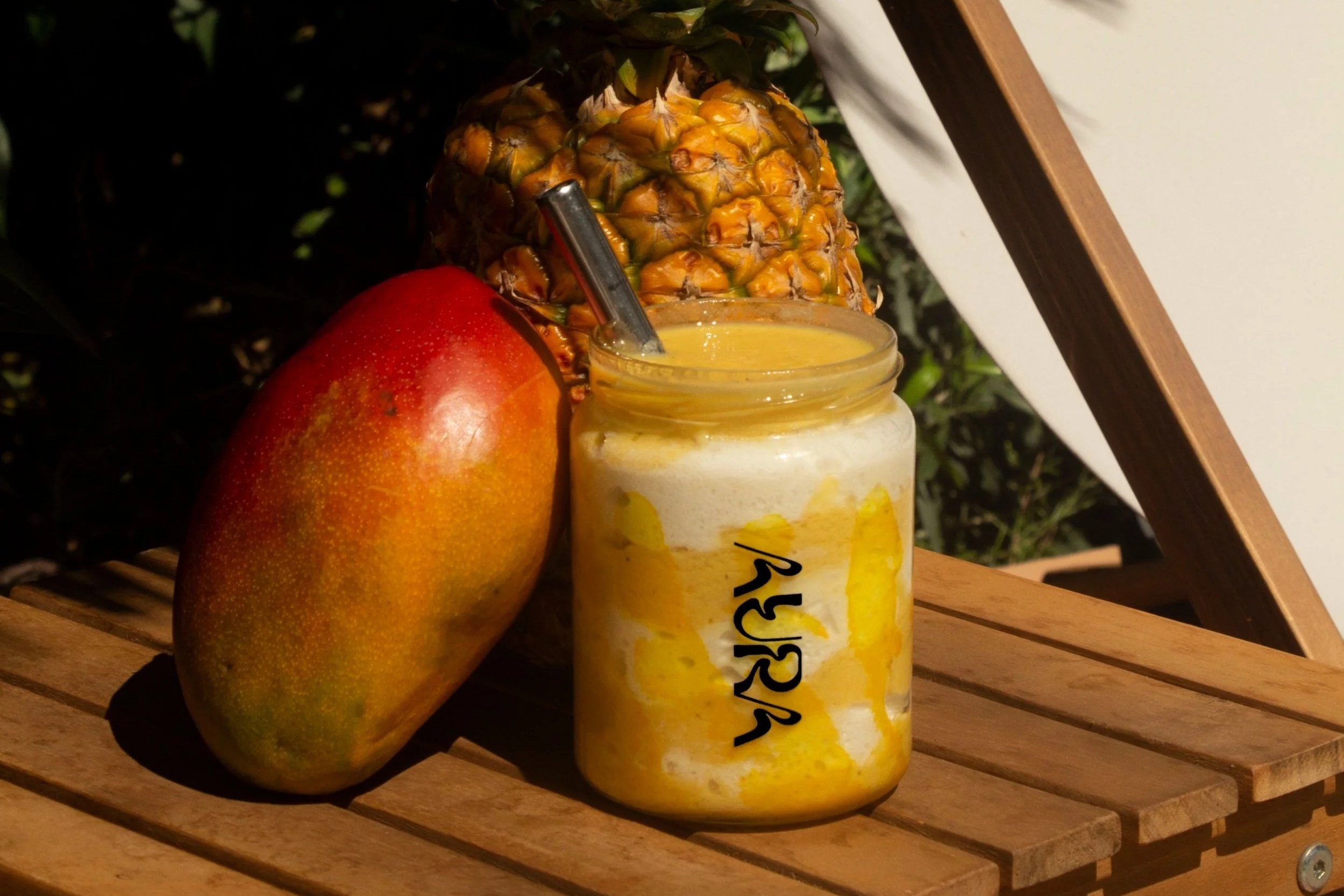
BLISS isn’t “just a smoothie with a trendy powder.” It’s a stack with a clear purpose:
Ashwagandha → stress signaling / cortisol support (where the human data is strongest)
Turmeric + fruit → antioxidant + anti-inflammatory support as part of a broader wellness pattern
Protein + fats → steadier energy (the calm you can actually feel at 4pm)
And yes — on our own BLISS page we describe it as supporting stress relief, mood balance, digestion, and immunity, with ashwagandha called out as an adaptogen in the formula.
How to think about dosing
Most clinical trials use standardized extracts in the ~125–600 mg/day range for 30–90 days, depending on the formulation.
In food form (like BLISS), the point isn’t to mimic capsule dosing perfectly. The point is:
regular exposure
paired with nourishment
inside a routine you’ll actually keep
That’s how wellness effects become real: repeatable, not dramatic.
Safety
Ashwagandha is “natural,” but it’s active.
Both NIH ODS and NCCIH note that it may be safe short-term (up to ~3 months) for many adults, with possible side effects like GI upset and drowsiness.
Key cautions you should actually respect:
Avoid in pregnancy / breastfeeding
Thyroid: an RCT in subclinical hypothyroidism found thyroid markers changed with ashwagandha root extract
Rare liver injury: documented in case series and summarized by NIH’s LiverTox (don’t ignore symptoms like jaundice/dark urine/itching)
Medication interactions: NIH ODS and NCCIH flag potential interactions (sedatives, thyroid meds, diabetes/BP meds, immunosuppressants)
Ashwagandha isn’t “calm.” It’s control: lower stress signaling, better sleep quality, and a nervous system that doesn’t overreact to everything.
If you want to try it the Aura way: BLISS is our house interpretation — functional, delicious, and designed for the part of wellness that matters most: what you can repeat.
Study links (so you can check the receipts yourself)
Aura BLISS smoothie (ingredients + function): https://www.aurawellnessbar.com/bliss-smoothie
NIH Office of Dietary Supplements — Ashwagandha (health professional): https://ods.od.nih.gov/factsheets/Ashwagandha-HealthProfessional/
NCCIH — Ashwagandha (usefulness + safety): https://www.nccih.nih.gov/health/ashwagandha
Meta-analysis (stress/anxiety/cortisol), PubMed record: https://pubmed.ncbi.nlm.nih.gov/39348746/
Systematic review + meta-analysis (sleep), PLOS ONE: https://journals.plos.org/plosone/article?id=10.1371/journal.pone.0257843
Meta-analysis (physical performance), Nutrients (PMC full text): https://pmc.ncbi.nlm.nih.gov/articles/PMC8006238/
Thyroid RCT (subclinical hypothyroidism), PubMed: https://pubmed.ncbi.nlm.nih.gov/28829155/
LiverTox (NIH) — Ashwagandha: https://www.ncbi.nlm.nih.gov/books/NBK548536/
Liver injury case series (PMC): https://pmc.ncbi.nlm.nih.gov/articles/PMC8041491/
